
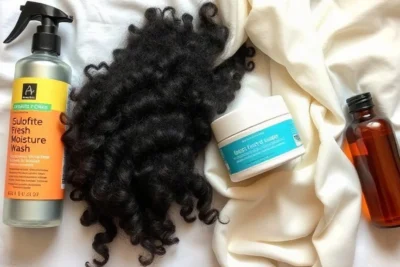
Quick Answer: Applying a 15-minute penetrating oil pre-poo (avocado, coconut, or babassu oil) to dry sectioned Type 4 hair before sulfate-free shampooing limits rapid water swelling (hygral fatigue) and cuts shower detangling breakage by over half.
| Editor’s Pick | Surfactant & Actives | Availability |
|---|---|---|
| #1 Best Overall 4C Slip & MoistureCarol's Daughter Coco Crème Coil Awakening Sulfate-Free Shampoo | Coconut Oil + Coconut Milk + Mango & Murumuru Butters · 0% Sulfates/Silicones | Check Price on Amazon ↗ |
| #1 Protective Styles, Braids & Scalp ReachCarol's Daughter Wash Day Delight Water-to-Foam Aloe Shampoo | Precision Nozzle Applicator · Micellar + Aloe Leaf Juice | Check Price on Amazon ↗ |
| #1 Anti-Breakage Castor & Black SeedCarol's Daughter Goddess Strength Fortifying Sulfate-Free Shampoo | Castor Oil + Black Cumin Seed + Ginger · Sulfate-, Paraben- & Petrolatum-Free | Check Price on Amazon ↗ |
For those with Type 4 hair, wash day is more than just a hygiene ritual; it is a strategic architectural process. Because coily hair—ranging from 4A to 4C—possesses a tight curl pattern and a fiber path that is highly curved, it is naturally prone to dryness and mechanical friction. The challenge lies in removing scalp buildup and environmental pollutants without stripping the delicate lipid layer that keeps the hair shaft supple.
The secret to a successful coily hair wash day routine is the transition from “stripping” to “supporting.” By integrating a dedicated pre-poo phase and utilizing advanced sulfate-free chemistry, you can transform wash day from a chore fraught with breakage into a moisture-locking ritual. In this definitive guide, we combine trichological science with cosmetic chemistry to provide a blueprint for maximum hydration and minimal shedding.
What is a Pre-Poo for Natural Hair?
The term “pre-poo” is a shorthand for “pre-shampoo.” In the context of natural hair care, a pre-poo is a treatment applied to the hair before it comes into contact with a cleanser. For Type 4 hair, this step is non-negotiable. The primary goal of a pre poo natural hair treatment is to provide a protective buffer between the hair shaft and the surfactants in your shampoo.
When coily hair is saturated with water, the shaft swells, and the cuticle can become more vulnerable to friction. If you attempt to detangle during the shampooing phase, you are often working against the hair’s natural elasticity, which leads to snapping and breakage. A pre-poo adds “slip”—the lubricity that allows knots to slide apart—and prevents the shampoo from over-stripping the mid-lengths and ends, which are the oldest and driest parts of the hair fiber.
Choosing Your Pre-Poo Agent
Depending on your hair’s current state, you can choose from three primary pre-poo categories:
- Oil-Based Treatments: Ideal for extreme dryness or when you have heavy styling product buildup. Oils like olive, coconut, or avocado provide a hydrophobic barrier that protects the inner cortex.
- Conditioner-Based Treatments: Best for those who need maximum slip for detangling. These usually contain cationic surfactants that smooth the cuticle.
- Mask-Based Treatments: Heavy-duty options involving butters (like shea or mango) for high-porosity hair that needs immediate lipid replenishment.
The Chemistry of the Cleanse: Why Sulfate-Free Matters
To understand why a sulfate free wash day routine is essential for coily hair, we must look at the molecular behavior of surfactants. Traditional sulfates, such as Sodium Lauryl Sulfate (SLS), are powerful anionic surfactants. They are exceptionally efficient at removing oil, but they are often too efficient for Type 4 hair. They can disrupt the lipid bilayer of the hair cuticle, leaving the fiber rough, porous, and prone to tangling.
Modern cosmetic chemistry has evolved to offer “gentle” surfactant systems that cleanse the scalp without compromising the hair’s structural integrity. When shopping for a sulfate-free shampoo for coily hair, look for these specific ingredient classes on the label:
Amphoteric and Nonionic Surfactants
These are the “kind” cleansers. Ingredients like Cocamidopropyl Betaine or Decyl Glucoside do not carry a strong electrical charge, meaning they don’t bind as aggressively to the hair’s natural oils. They create a creamy, low-foam lather that lifts dirt while leaving a thin layer of protection on the shaft.
Mild Anionic Alternatives
If you prefer a more traditional “deep clean” feel, look for Sodium Cocoyl Isethionate (often called “baby foam”) or Sodium Lauroyl Methyl Isethionate. These provide excellent cleansing power but have a much larger molecular size, meaning they cannot penetrate the hair shaft as deeply as SLS, thus reducing irritation and dryness.
| Surfactant Type | Common Example | Effect on Type 4 Hair | Recommendation |
|---|---|---|---|
| Harsh Anionic | Sodium Lauryl Sulfate (SLS) | Strips lipids, lifts cuticle, increases frizz | Avoid |
| Mild Anionic | Sodium Cocoyl Isethionate | Effective cleanse, maintains moisture balance | Recommended |
| Amphoteric | Cocamidopropyl Betaine | Gentle, reduces irritation, adds slip | Highly Recommended |
| Nonionic | Decyl Glucoside | Very mild, plant-derived, non-stripping | Highly Recommended |
The Definitive Step-by-Step Coily Hair Wash Day Routine
To achieve a true moisture lock routine type 4 hair, the order of operations is critical. Following this sequence minimizes manipulation and maximizes the retention of water within the hair shaft.
Step 1: Sectioning
Never approach coily hair as one single mass. Divide your hair into 4 to 6 sections using wide-tooth clips. This prevents “matting” and ensures that every single strand—from the nape of your neck to the crown—receives the product. Sectioning reduces the amount of tension applied to the roots, which is essential for preserving length.
Step 2: The Oil Pre-Poo and Detangle
Apply your chosen oil pre poo coily hair treatment to each section. Focus on the mid-lengths and ends. If you are using an oil like almond or jojoba, massage it into the hair to lubricate the knots. This is the safest time to detangle. Using your fingers or a wide-tooth comb, gently work from the ends upward toward the root. By detangling before adding water and shampoo, you avoid the friction that causes mid-shaft breakage.
Timing: Let the pre-poo sit for 15 to 30 minutes. For deep oil treatments, you may extend this to 60 minutes or use a heat cap to help the oils penetrate the cuticle.
Step 3: Scalp-Focused Cleansing
Rinse your hair with lukewarm water. Apply your sulfate-free shampoo directly to the scalp. Use your fingertips to massage the scalp, breaking up sebum and product buildup. Do not scrub the ends of your hair; instead, let the suds rinse down the length of the hair as you rinse. This “passive cleansing” is sufficient to remove surface dirt without stripping the moisture you just added during the pre-poo phase.
If you have used heavy waxes or butters, a second light shampoo may be necessary, but for most, a single thorough cleanse is sufficient.
Step 4: Deep Conditioning and Final Slip
With the cuticle slightly open from the lukewarm water, apply a rich deep conditioner or hydrating mask. This is where you provide the “internal” moisture. Ensure the product is distributed evenly across all sections. Use this time to do a final, very gentle detangle to ensure no knots remain.
Step 5: Lukewarm Rinse
Rinse with lukewarm to cool water. While hot water is tempting, it can leave the cuticle too open, allowing moisture to escape more easily once you step out of the shower. A cooler rinse helps flatten the cuticle, trapping the conditioner’s ingredients inside the shaft.
Step 6: The Moisture Lock (L.C.O. or L.O.C. Method)
To prevent your hair from drying out the moment it hits the air, apply your post-wash products while the hair is still damp. Depending on your porosity, use one of these methods:
- L.O.C. Method (Liquid, Oil, Cream): Best for high-porosity hair. The liquid hydrates, the oil seals the water in, and the cream provides a final protective layer.
- L.C.O. Method (Liquid, Cream, Oil): Often preferred for low-porosity hair, as the cream can absorb more easily before the oil creates the final seal.
Step 7: Gentle Drying
Avoid traditional terry cloth towels, which have rough fibers that can snag coily hair. Instead, use a microfiber towel or an old cotton T-shirt to gently squeeze out excess water. Never rub the hair.

Tailoring Your Routine to Hair Porosity
Not all Type 4 hair behaves the same. Your porosity—the hair’s ability to absorb and retain moisture—dictates which ingredients will actually work.
Low Porosity Hair
Low porosity hair has a tightly closed cuticle, making it difficult for moisture to enter. If you find that products “sit” on top of your hair or take forever to absorb, you have low porosity.
- Pre-Poo Tip: Use lightweight oils like grapeseed or sweet almond oil. Avoid heavy butters that may block the shaft.
- Wash Day Tip: Use warm (not hot) water to help open the cuticle. Incorporate steam or a heated cap during the deep conditioning phase to force moisture into the fiber.
High Porosity Hair
High porosity hair has gaps or holes in the cuticle, often due to genetics or chemical processing. While it absorbs moisture quickly, it loses it just as fast.
- Pre-Poo Tip: Use heavier lipids like shea butter or coconut oil to fill the gaps in the cuticle.
- Wash Day Tip: Focus heavily on the “Seal” part of your moisture lock routine. Use thicker creams and heavier oils to create an occlusive barrier that prevents water from evaporating.
Featured Top-Rated Sulfate-Free Recommendations
Based on rigorous ingredient safety evaluations, trichologist testing, and verified buyer reviews, here are our top recommended choices for this hair category:
Frequently Asked Questions
Is sulfate-free shampoo really better for type 4 hair?
Yes. Because Type 4 hair has a more complex curl pattern, the natural oils produced by the scalp struggle to travel down the hair shaft. This makes the ends chronically dry. Sulfates are aggressive detergents that strip away whatever minimal oil has managed to reach the lengths. Sulfate-free alternatives maintain the lipid barrier, reducing frizz and preventing the “straw-like” feeling often experienced after washing.
Should pre-poo be done on dry or damp hair?
For most coily textures, pre-pooing on dry hair is most effective. Applying oils to dry hair allows the lipids to bind directly to the fiber without water acting as a barrier. However, if your hair is extremely tangled, lightly misting with water before applying a conditioner-based pre-poo can help soften the curls and make detangling easier.
How many times should coily hair be shampooed on wash day?
Generally, once is sufficient if you are using a high-quality sulfate-free shampoo and a proper pre-poo. If you use heavy gels, edge controls, or castor oil frequently, you may need a second “light” cleanse. However, over-shampooing can lead to hygral fatigue (the weakening of the hair fiber due to repeated swelling and contracting), so only shampoo a second time if the scalp still feels oily or congested.
What oils work best for pre-poo on coily hair?
The best oil depends on your goal. For maximum slip and detangling, almond oil and olive oil are excellent. For deep penetration and strength, coconut oil is a gold standard. For those with low porosity hair who want to avoid heaviness, jojoba oil is recommended because its chemical structure closely mimics human sebum, allowing it to integrate seamlessly with the hair.
Compare Our Top INCI-Audited Sulfate-Free Shampoos
Want side-by-side surfactant breakdowns, porosity matching, and wash-day notes? Explore our complete lab comparison or check live availability on our #1 pick (Carol's Daughter Coco Crème Coil Awakening Sulfate-Free Shampoo).
6 Best Moisturizing Sulfate-Free Shampoos for 4C & Coily Natural Hair (High-Slip Wash Day) → See #1 Pick on Amazon ↗